







A decline in website traffic can be alarming. For years, businesses have been conditioned to view increasing website traffic as a primary measure of successful SEO. More visitors meant better rankings, greater visibility and, presumably, more opportunities to generate leads.
But website traffic alone doesn’t tell you whether your SEO program is working. In fact, a website can receive less organic traffic while attracting a much better audience and generating more sales (conversions).
More Traffic Isn’t Necessarily Better Traffic
Imagine two websites. One receives 10,000 visitors each month, and another receives 7,000 visitors, but the first company’s bounce rate is 68%, while the second company’s is only 15%. Meaning, the 2nd company actually has more real traffic.
The objective of SEO shouldn’t simply be to generate the largest possible number of visitors. It should connect the business with people actively interested in the products, services, and solutions it provides.
When Traffic Declines but Engagement Improves
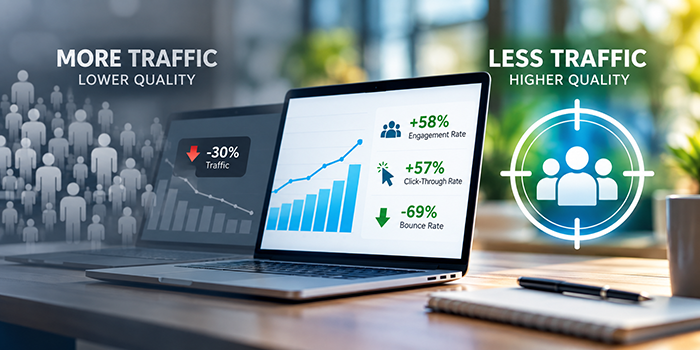
Consider an actual SEO performance scenario. Organic website traffic declines approximately 30% compared with the previous year. At first glance, those numbers might appear concerning. But now consider what is happening with the people who are actually visiting the website:
- Engagement rate increased (An engagement is a site visit that lasts longer than 10 seconds, has 2 or more page views, or triggers a conversion)
- Click-through rate increased (The number of end users who clicked on your website link in a search result)
- Bounce rate decreased (A bounce rate is the percentage of visitors who landed on a page but left the entire website within 10 seconds)
Suddenly, the picture looks very different. The higher click-through rate indicates that a greater percentage of people seeing relevant search listings to their search query are choosing to visit the website. Once they arrive, the higher engagement rate and substantially lower bounce rate suggest visitors have more reasons to interact with the site’s content rather than leave immediately.
Those are important signals of traffic quality, not simply traffic quantity, driven by long-tail keyword phrases and target audience focused page content.
Effective SEO Focuses on Search Intent
Traditional SEO often focused on generic keywords that could generate large search volumes. A company might rank for a general phrase and receive hundreds or thousands of visitors. The problem was that many of those visitors weren’t necessarily potential customers.
Modern SEO takes a much more targeted approach. Instead of concentrating on high-volume keywords, businesses can develop content around specific keyword phrases, customer questions, service needs, problems and buying intentions.
Someone searching a broad term may simply be researching a subject, whereas an end user querying with a detailed phrase describing a specific problem, product, or service provides much more information about what they actually need. These are the individuals we want to visit our website; they may generate lower search volumes, but represent a significantly more valuable visitor.
Target Audiences Matter More Than Raw Visitor Numbers
The same principle applies to website content. Effective content shouldn’t attempt to appeal to everyone. It should be created for the audiences most likely to become customers.
For a manufacturer, that audience might include plant managers, maintenance supervisors, engineers and purchasing professionals. For a local service business, it might include homeowners within particular communities searching for a specific service. For a B2B company, the most valuable visitor may be someone researching a highly specialized solution that generates only a fraction of the search volume of a broader industry term.
When SEO content is developed around these audiences, overall traffic can decrease because the website attracts fewer irrelevant visitors.
Long-Tail Keyword Phrases Produce Pre-Qualified Visitors
This is also why long-tail keyword phrases have become increasingly valuable.
Instead of targeting a generic phrase such as ‘pump’ a company might develop content around searches such as ‘industrial pump repair services’ or ‘repair or replace an industrial pump’.
These searches may occur less frequently, but they reveal considerably more about the searcher’s intent. The person isn’t simply interested in pumps. They may have a pump problem and be looking for a company that can solve it.
Look at the Entire SEO Picture
This doesn’t mean a decline in organic traffic should automatically be considered good news. Always investigate a significant traffic decline. Rankings may have changed. Search demand may have declined. Competitors may have gained visibility. Search engine result pages may have changed, or a website may have technical issues affecting its organic performance.
But don’t evaluate traffic in isolation. Businesses should also examine metrics such as click-through rate, engagement rate, bounce rate, conversions, form submissions, phone calls and other meaningful actions.
If traffic declines while engagement, click-through rates and conversions improve, the SEO program may be becoming more efficient at attracting the people the business actually wants to reach.
The Goal Isn’t More Traffic – It’s Qualifying Visitors
SEO has never truly been about generating website visitors for the sake of generating website visitors. The business objective is to create opportunities. That means appearing for the right searches, developing content around the needs of specific target audiences, and helping potential customers find useful information when they need it.
A website attracting 30%-40% fewer visitors than last year doesn’t automatically mean your SEO program is not effective, it likely means it is performing very well.
Frequently Asked Questions: Analyzing An Effective SEO Program
Q: Is a decline in organic website traffic always bad?
A: No. A decline in organic traffic should be investigated, but it does not automatically mean SEO performance is getting worse. If engagement, click-through rates, conversions, and other quality metrics are improving, the website may be attracting fewer but more relevant visitors.
Q: Why would website traffic decrease while engagement increases?
A: This can happen when SEO efforts become more focused on specific keyword phrases and target audiences. Broad searches may generate more visitors, but targeted searches often bring people who are more interested in a company’s actual products, services, or solutions.
Q: What is qualified website traffic?
A: Qualified traffic consists of visitors whose needs and search intent closely match what a business offers. These visitors are more likely to explore service or product pages, read additional content, submit an inquiry, call the business, or take another meaningful action.
Q: Are long-tail keywords better than high-volume keywords?
A: Neither is automatically better. High-volume keywords can provide valuable visibility, while longer and more specific keyword phrases often reveal stronger search intent. A balanced SEO strategy targets terms based on their relevance and potential business value rather than search volume alone.
Q: What SEO metrics should businesses monitor besides organic traffic?
A: Businesses should evaluate organic traffic alongside search impressions, click-through rate, engagement rate, bounce rate, conversions, leads, phone calls, form submissions, and other actions that contribute to business objectives.
Q: When should a decline in organic traffic be concerning?
A: A traffic decline deserves closer attention when it is accompanied by falling rankings, lower engagement, fewer conversions, declining leads, technical website problems, or reduced visibility for important products and services. Traffic should always be evaluated within the broader context of SEO and business performance.